Market Recap (3/22/26)
Market Recap of the Week of Mar 15, 2026 - Mar 22, 2026
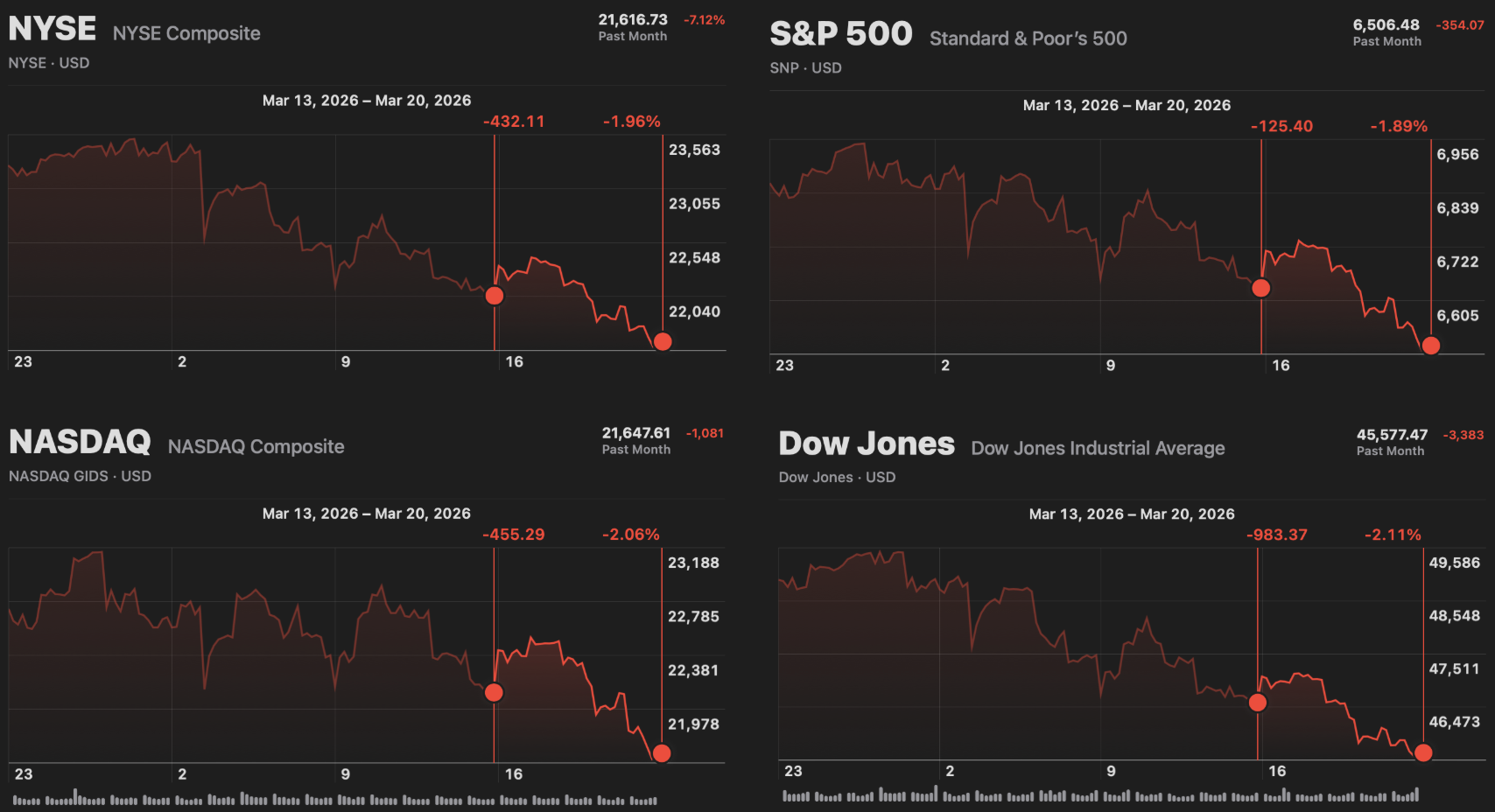
Source: Apple Stocks Application
Overall Market Trends:
The stock market continued to see sharp declines for the fourth straight week, as all four major indices finished the week in the red. The New York Stock Exchange Composite fell 432 points (-1.96%), the S&P 500 slid 125 points (-1.89%), the NASDAQ Composite sank 455 points (-2.06%), and the Dow Jones Industrial Average posted a weekly loss of 983 points (-2.11%). These results were largely influenced by geopolitical tensions in the Middle East, centered on the Iran war and its effects, such as on the Strait of Hormuz.
Stocks rebounded on Monday while oil prices pulled back. Meta (NASDAQ: META) stock rose over 2% after a report was released claiming that the company is planning on laying off over 20% of its current workforce. Crude oil prices finally retreated after consistently rallying since the start of the Iran war due to complications with the Straight of Hormuz. Prices fell just over 5%, settling at $93.50 after trading above $100 per barrel overnight, after Treasury Secretary Scott Bessent signaled that the U.S. would not interfere with Iranian oil shipments and is preparing a multinational naval coalition to escort tankers through the Strait of Hormuz. The move eased concerns around supply disruptions in one of the world’s most critical oil chokepoints, pushing prices lower. Despite Monday’s gains, volume was not strong, something investors look towards for conviction.
The momentum continued into Tuesday’s trading session. While oil prices reversed, going back into the green after comments from Trump, the broader market was uplifted by gains in Expedia Group (NASDAQ: EXPE) and Booking Holdings (NASDAQ: BKNG) after both Delta Airlines (NYSE: DAL) and American Airlines (NASDAQ: AAL) posted strong revenue guidance.
The market tumbled on Wednesday after inflationary concerns arose. The Federal Reserve decided to hold rates steady between the 3.5% to 3.75% range, citing that the “implications of the developments in the Middle East for the U.S. economy are uncertain” during post-meeting remarks. The producer price index (PPI) also raised anxiety after it came in at a 0.7% gain during February, well exceeding the 0.3% estimate and displaying how inflation is already in a perilous spot before the Iran war even broke out. Oil pushed higher, settling at over $107 per barrel, after Israel reportedly struck Iran’s biggest gas processing facility. Additionally, Iran has threatened to strike oil facilities in Qatar, Saudi Arabia, and the United Arab Emirates after already launching attacks on the UAE’s energy infrastructure earlier this week.
U.S. equities continued to retreat throughout Thursday’s session. Oil price fluctuations eased after Israeli Prime Minister Benjamin Netanyahu said the country was helping the U.S. to open the Straight of Hormuz and that the war may be over sooner rather than later after claiming Iran lost its ability to enrich uranium and make ballistic missiles. Earlier in the session, Iran struck a key LNG export facility in Qatar, in which Trump responded by threatening to “massively blow up the entirety of the South Pars Gas Field.”
Stocks continued to tank after Iran and Israel exchanged strikes overnight. Iran launched new attacks, this time targeting energy sites in the Persian Gulf region. The U.S. is sending additional Marines to the Middle East in response. Iraq has also declared force majeure, a legal declaration that allows one to avoid fulfilling contractual obligations due to events outside its control, on all oilfields operated by foreign companies, further adding to oil’s upward momentum.
Source: CNBC (Consumer News and Business Channel)
Past Earnings Report:
This Week in Crypto
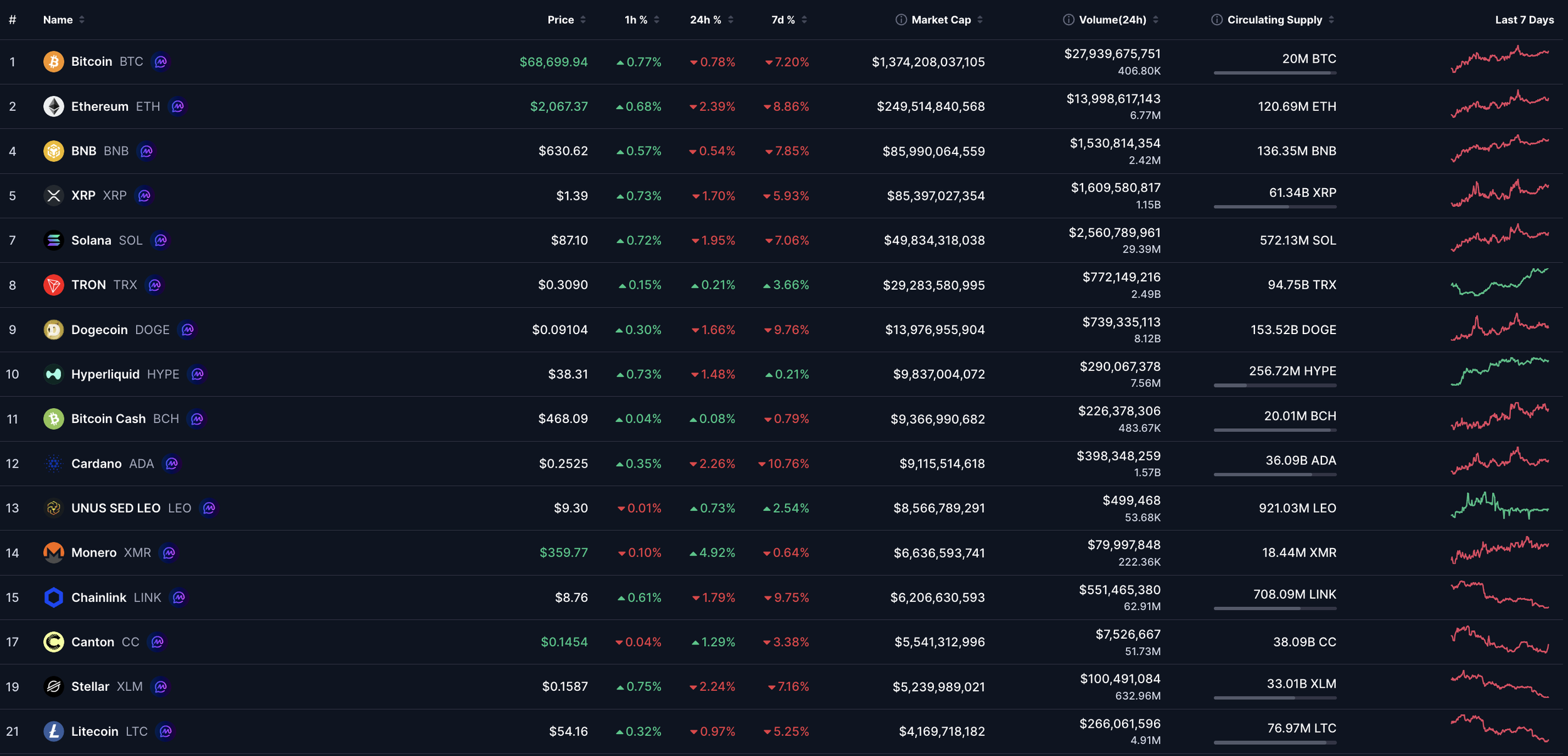
Source: CoinMarketCap
Market Trends:
Crypto spent the week rallying into the Fed and then giving it all back as macro pressure took over. Total market cap opened around $2.51 trillion, briefly touched $2.55 trillion mid-week, and closed near $2.35 trillion, down roughly 6.45% on the week. Bitcoin finished at $68,699, off 7.20%, while Ethereum fell 8.86% to $2,067. Losses were broad across large-caps: SOL down 7.06%, BNB down 7.85%, XRP down 5.93%, DOGE down 9.76%, ADA down 10.76%, and LINK down 9.75%. TRON was one of the only names with anything to show for the week, gaining 3.66%. Hyperliquid held up better than almost everything else, essentially flat at +0.21%. Fear and Greed closed at 26, down from neutral territory a week prior, but well above the extreme fear readings from a month ago.
Prices moved higher on Sunday, the best day of the week. Bitcoin was trading above $74k with derivatives turning bullish as large put hedges unwound, and memecoins like PEPE, BONK, and SHIB were outperforming the majors. The setup looked good heading into a heavy macro week, and risk appetite was as strong as it would get all week.
The rally extended on Monday, with BTC briefly tagging the $75k-$76k range before slipping. XRP broke $1.50 and reclaimed the number four spot by market cap. Crypto funds reported roughly $1.06 billion in net inflows for the prior week, mostly into BTC and ETH vehicles. The numbers looked good on paper, but the move was largely derivatives-driven. There was not enough fresh spot demand underneath it to make the breakout stick.
Momentum took a turn on Tuesday after selling hit hard. US equities had one of their worst sessions in months, erasing around $820 billion in market value in a single day, and crypto dropped roughly $120 billion in market cap in parallel. The Fed held rates, but Powell's tone around inflation, with oil pushing toward $100 on Iran war headlines, read more hawkish than anyone wanted. The SEC dropped a framework mid-week, classifying 16 major tokens, including Litecoin and Cardano, as digital commodities outside securities law, which would have been meaningful in a calmer week. Nobody cared as equities were selling off hard.
Pressure continued on Wednesday as a hotter-than-expected Philly Fed manufacturing print reinforced the higher-for-longer narrative. Gold caught a bid as the actual safe haven, while crypto kept drifting lower. Some alt outliers like HYPE held up, but breadth was weak, and the tape reflected it.
Prices ground sideways to lower on Thursday with volume drying up and derivatives open interest falling from roughly $429 billion to $388 billion as traders on both sides trimmed exposure. Bitcoin was sitting on the $70k-$71k support zone. There was no dramatic flush, just steady derisking and declining participation as the week wore on.
Mild stabilization developed on Friday, with total market cap edging toward $2.42 trillion. The Senate reached a compromise on stablecoin yield provisions that had been blocking the Digital Asset Market CLARITY Act, and Congress locked in a hearing on tokenization for March 25. Neither was a near-term price catalyst, but it helped the structural narrative.
Markets drifted back toward $2.36 trillion on Saturday. A DeFi exploit around Resolv and USR added some noise but stayed contained, and the session ended choppy with social sentiment split between extreme bull calls and warnings of a bigger dump ahead.
BTC held up better than alts, leverage came down, and ETF flows stayed positive for institutional vehicles. But the week made clear that until the macro backdrop shifts, rallies built on derivatives and short covering are going to keep running into walls.
Live Crypto Markets:
Looking Towards the Future
Upcoming Important Economic Events:
Monday: Federal Reserve governor Stephen Miran TV appearance
Tuesday: U.S. productivity (revision) • S&P flash U.S. services PMI • S&P flash U.S. manufacturing PMI
Wednesday: Import price index
Thursday: Initial jobless claims • Various Fed governors speak
Friday: Consumer sentiment (final)
Future Earnings Reports: