Market Recap (3/15/26)
Market Recap of the Week of Mar 8, 2026 - Mar 15, 2026
Source: Apple Stocks Application
Overall Market Trends:
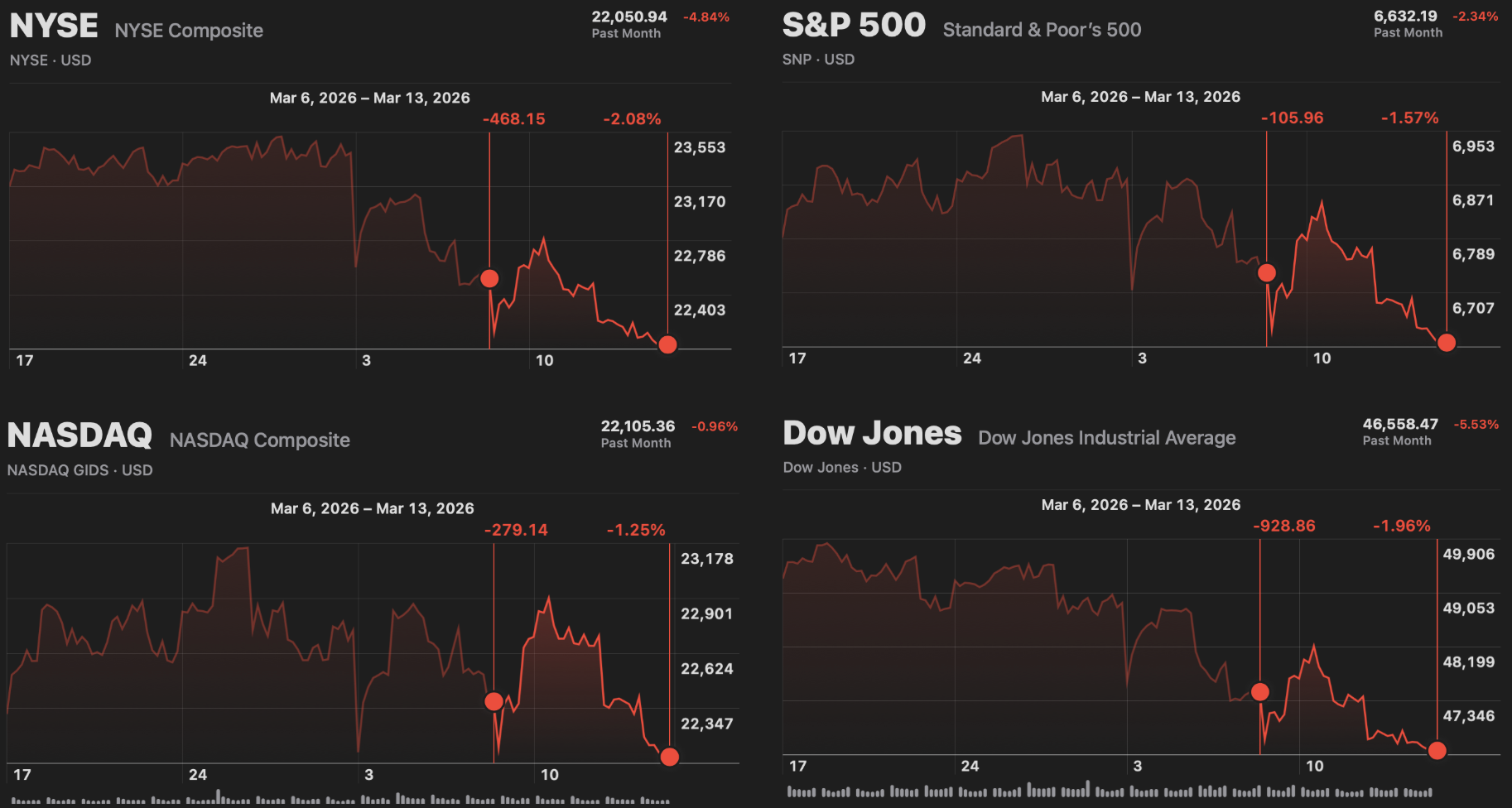
The stock market saw its second straight week of losses, as all four major indices finished in the red. The New York Stock Exchange Composite fell 220 points (-0.90%), the S&P 500 slid 32 points (-0.47%), the NASDAQ Composite sank 279 points (-1.25%), and the Dow Jones Industrial Average posted a weekly loss of 929 points (-1.96%). These results were largely influenced by heightened geopolitical tensions in the Middle East.
Stocks opened deep in the red Monday but fought back to close in the green after Trump told a CBS reporter that the war against Iran is "very complete, pretty much" and that ships are moving through the Strait of Hormuz. Semiconductors led the comeback. Broadcom (NASDAQ: AVGO) jumped over 4%, Micron Technology (NASDAQ: MU) and Advanced Micro Devices (NASDAQ: AMD) each gained 5%, and Nvidia (NASDAQ: NVDA) added over 2%. Oil whipped around all session, briefly breaking above $100 a barrel overnight before Trump's comments sent WTI pulling back to around $81. The $100 level was widely seen as the breaking point for the economy, so the retreat in crude was exactly what the market needed to stage its comeback.
Tuesday was a choppy, mostly directionless session as oil gave back a big chunk of its recent gains, but the Iran situation stayed unsettled. WTI cratered nearly 12% to $83.45 on reports that a group of countries would tap emergency reserves to offset supply disruptions. Prices bounced around after Energy Secretary Chris Wright posted, then quickly deleted, a social media post claiming the Navy had escorted a tanker through the Strait. The White House walked it back and confirmed no tanker had actually made it through, which sent oil bouncing back off its lows. CBS News also reported Iran was showing signs of moving toward mining the Strait, keeping a ceiling on any real optimism.
Stocks were essentially flat on Wednesday, but the Dow lagged as oil climbed back and the Iran conflict showed no signs of resolution. WTI rose over 4% to $87.25, and Brent gained nearly 5% to $91.98, shrugging off the IEA's record 400 million barrel reserve release. Three cargo ships off Iran's coast were struck by projectiles during the session, which did not help the mood. Oracle (NYSE: ORCL) was a bright spot, jumping 9% after beating on earnings and revenue for its fiscal third quarter and raising its 2027 revenue forecast. CPI for February came in at 2.4% year over year, right in line with expectations, which was at least one clean data point in an otherwise messy week.
Thursday was ugly. All three indexes closed at new 2026 lows as oil surged and Iran's newly appointed Supreme Leader, Mojtaba Khamenei, said the Strait of Hormuz should stay closed as a tool to pressure the enemy. Brent crude closed above $100 for the first time since August 2022, and WTI surged nearly 10% to $95.73. Energy Secretary Wright added to the concern, saying the Navy is not ready to escort tankers through the Strait yet. Morgan Stanley (NYSE: MS) led financials lower after capping private credit fund withdrawals. Chevron (NYSE: CVX) and Exxon Mobil (NYSE: XOM) were among the few names in the green.
Stocks closed the week out lower Friday as oil kept climbing and nothing changed on the Iran front. WTI settled at $98.71, and Brent held above $100 for a second straight session. Hegseth told reporters at the Pentagon not to worry about the Strait closure, which did not do much to calm anyone down. The stagflation talk on Wall Street is getting louder as rising energy costs threaten to push inflation back up while growth concerns mount. Fed rate cut expectations are getting pushed out, with futures markets no longer pricing in a September cut.
Source: CNBC (Consumer News and Business Channel)
Past Earnings Report:
This Week in Crypto
Source: CoinMarketCap
Market Trends:
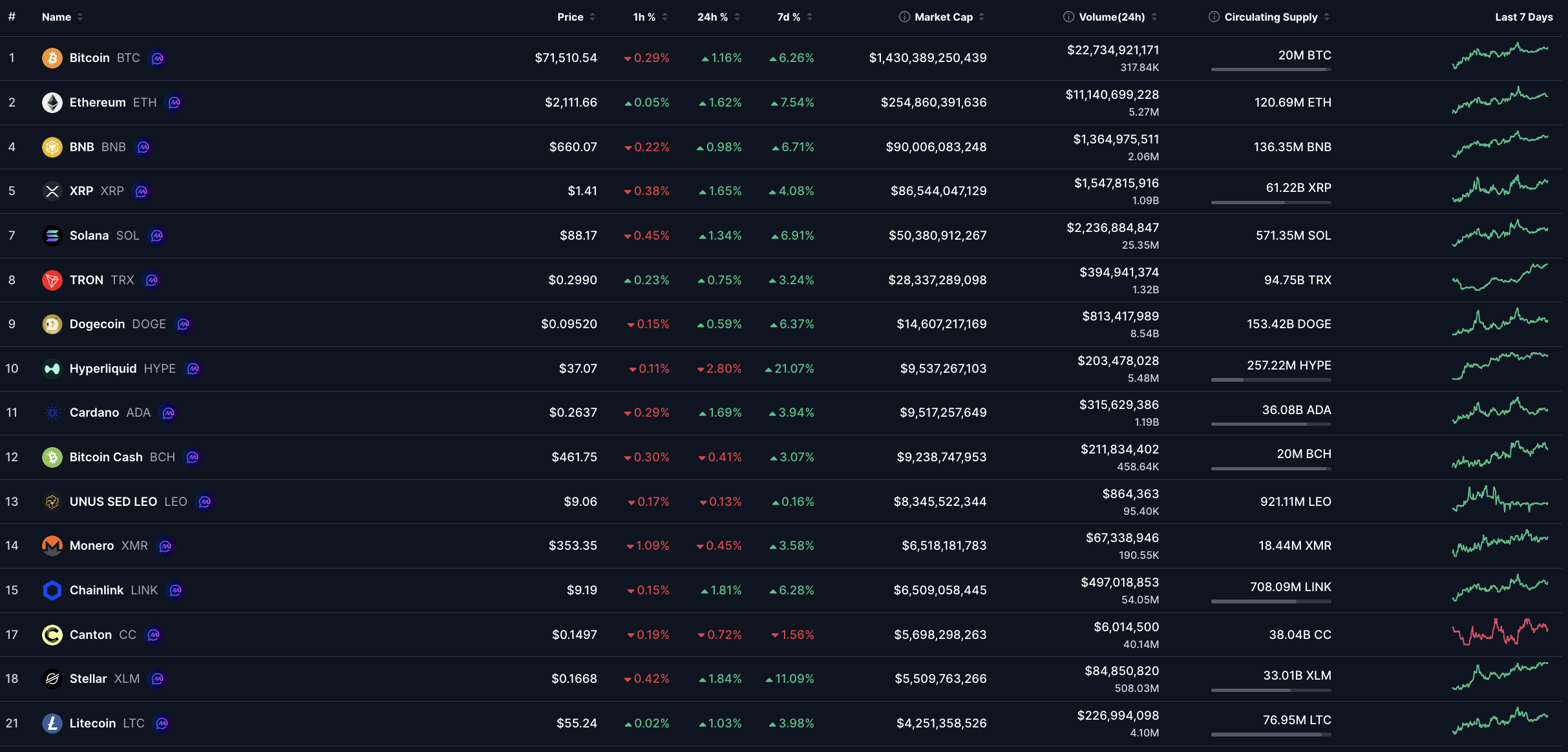
The crypto market strung together a second straight recovery week, with total market capitalization climbing from approximately $2.30 trillion to $2.45 trillion, roughly +6% on the week. Bitcoin (BTC) finished at $71,510 (+6.26%) while Ethereum (ETH) closed at $2,111 (+7.54%). Large-cap altcoins were broadly positive, with Hyperliquid (HYPE) once again leading at +21.07%, Stellar (XLM) up 11.09%, Solana (SOL) up 6.91%, BNB up 6.71%, and Dogecoin (DOGE) gaining 6.37%. XRP added 4.08% while Cardano (ADA) and Bitcoin Cash (BCH) posted more modest gains of 3.94% and 3.07%, respectively. Canton (CC) was the only decliner among large-caps, slipping 1.56%. Easing geopolitical tensions, repeated short squeezes, and continued spot BTC ETF inflows drove most of the week's gains.
Crypto prices moved higher on Monday as the market got its first real relief in weeks. Geopolitical tensions around the Iran-US-Israel conflict showed signs of calming compared to the prior week, which took some pressure off risk assets broadly. Early spot BTC ETF inflows started showing up, and shorts were still heavily crowded coming off weeks of extreme fear. The session was quiet, but the tone was noticeably different.
Prices extended further on Tuesday, with total market cap pushing to around $2.41 trillion and making it the strongest single day of the week. The narrative around war risk easing and oil pulling back gained traction, lowering the worst-case inflation fears that had been hanging over the market. Shorts were still heavy going into the session, and open interest climbed alongside prices to about $425 billion as they were forced to cover. ETF flow trackers also reported meaningful net inflows into BTC products on the day.
Volatility slowed on Wednesday as total market cap dipped slightly to around $2.39 trillion and the market took a breather. Traders shifted attention toward upcoming U.S. inflation data and central bank meetings, and the mood turned into a wait-and-see situation. Liquidations hit both sides throughout the session as the market chopped around after two strong days. Sentiment kept improving but was still nowhere near neutral.
Thursday was a relatively flat day, with total market cap hovering near $2.39 trillion and volume easing toward the $90 billion range. Major banks pushed rate cut expectations further out into 2026, citing higher oil and sticky inflation, which was a headwind. Stablecoin supply continued growing, though, and BTC and ETH ETF AUM nudged higher, showing capital was not leaving. No fresh shock emerged, and some traders quietly rebuilt positions on the dip.
Prices spiked on Friday, with total market cap briefly touching around $2.46 trillion for the week's high. News of large strategic reserve releases and more active diplomatic efforts in the Middle East sent oil prices sharply lower, triggering a broad risk-on move across assets. Another round of short liquidations hit BTC and the majors, spot ETF inflows continued, and altcoins joined in. BTC dominance kept ticking up, though, so this was still a BTC-led move.
Selling pressure came back on Saturday as traders took profits after Friday's run. Total market cap pulled back to around $2.41 trillion, and open interest dropped to about $402 billion despite volume staying elevated near $120 billion, pointing to leverage being unwound rather than added. Weekend headlines were mixed, with infrastructure and protocol stories on one side and reminders that geopolitical and policy risks had not gone away on the other. Sentiment improved from extreme fear to fear on the week, but not much further than that.
Crypto prices recovered back toward roughly $2.45 trillion on Sunday as the market held most of the week's gains into the close. Volume thinned to around $60 billion on weekend liquidity, and open interest settled near $392 billion. The Fear & Greed Index ended the week at 33, up from 17 the week prior. Panic is fading, but confidence is still a long way from where it needs to be.
Short squeezes and ETF inflows carried most of the weight again this week, and rate cut expectations getting pushed further out is still a real headwind for the market. The back-to-back recovery weeks are encouraging, but the structure does not yet point to a full trend reversal. The market still needs to see inflows hold up over multiple consecutive weeks before that changes.
Live Crypto Markets:
Looking Towards the Future
Upcoming Important Economic Events:
Monday: Empire State manufacturing survey • Industrial production • Capacity utilization
Tuesday: Home builder confidence index
Wednesday: Producer price index (PPI) • Core PPI • FOMC interest-rate decision
Thursday: Initial jobless claims • Philadelphia Fed manufacturing survey
Friday: Nothing Scheduled
Future Earnings Reports: