Market Recap (3/1/26)
Market Recap of the Week of Feb 22, 2026 - Mar 1, 2026
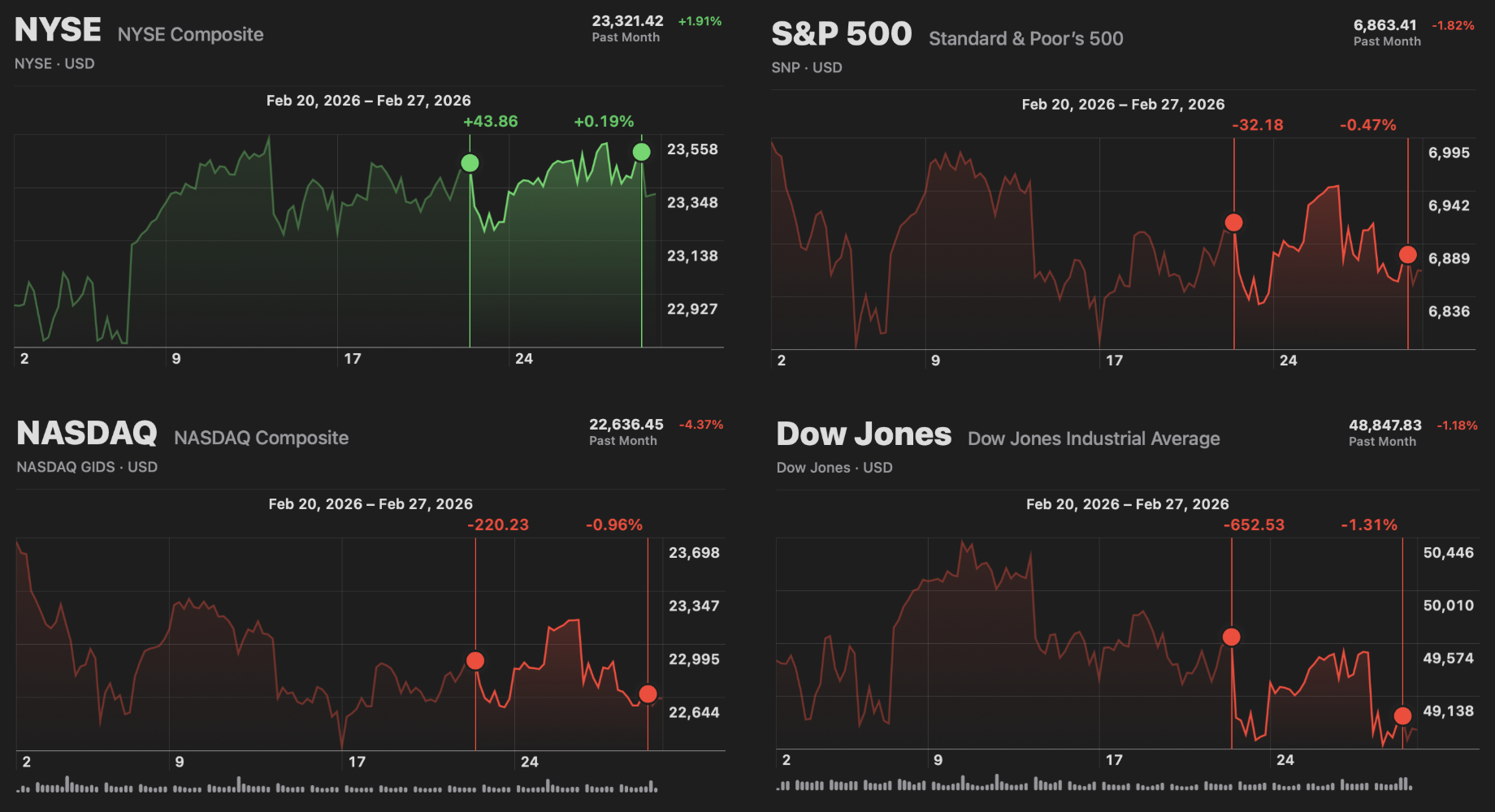
Source: Apple Stocks Application
Overall Market Trends:
The majority of the stock market declined last week, with three out of the four major indices finishing in the red. The NASDAQ Composite fell 220 points (-0.96%), the S&P 500 slid 32 points (-0.47%), and the Dow Jones Industrial Average sank 653 points (-1.31%). The sole winner of the week was the New York Stock Exchange Composite (NYSE), which posted weekly gains of 44 points (+0.19%). Yet again, this week’s results were largely influenced by market sentiment revolving around artificial intelligence disruption across multiple industries.
Stocks plummeted on Monday as artificial intelligence disruption fears continued to wreak havoc in the market. IBM (NYSE: IBM) plunged 13% after Anthropic, the parent company of A.I. powerhouse Claude AI, outlined new programming abilities for its Claude code product. Microsoft (NASDAQ: MSFT) and CrowdStrike (NASDAQ: CRWD) also took a hit from the A.I. disruption fears, declining 3% and 10%, respectively. Concerns about A.I.’s long-term effect on the economy were also put in perspective after Citrini Research released a research paper displaying that the AI boom would lead to 10% in unemployment, ultimately hurting the broader economy. This paper caused software and financial stocks to plummet. American Express (NYSE: AXP) tanked 7% while Mastercard (NYSE: MA) crashed 6%. Tariffs also weighed down on the market after Trump said over the weekend that he would raise the global tariff rate to 15% from the original 10%.
Stocks reversed throughout Tuesday’s session. AI disruption fears eased after Anthropic announced new avenues to connect its product Claude Cowork to companies’ existing apps. This resulted in software stocks rebounding. Advanced Micro Devices (NASDAQ: AMD) shares soared 8.8% after Meta Platforms (NASDAQ: META) reported a multiyear deal with the company. Salesforce (NYSE: CRM), one of the notable software gainers, rose 4% on the day.
The positive momentum carried over into Wednesday’s trading session as the market saw gains. Nvidia (NASDAQ: NVDA) rose 1.4% as investors prepared for the company’s earnings report set to be released after market close. Tuesday evening, President Trump held his State of the Union address, where he praised the current state of the economy.
This momentum reversed, however, on Thursday as Nvidia’s earnings reports missed the mark. Despite the company originally jumping roughly 5% immediately after the release in after-hours trading, the company ended the day down over 5%. Other chip stocks followed suit. Despite issuing disappointing revenue guidance for 2027, Salesforce climbed 4% on the day after beating top and bottom lines in its Q4 earnings report.
The losses persisted, with the market declining on Friday as A.I. fears resumed. Jack Dosey’s fintech company, Block, laid off nearly 5,000 employees, just under half of the company’s entire workforce, causing other financial sector stocks to drop. Many private credit companies also came under fire on Friday after Market Financial Solutions, a UK mortgage provider, collapsed. Shares of Apollo (NYSE: APO) pulled back over 8% while Jefferies (NYSE: JEF) declined more than 9%, respectively. Blue Owl Capital (NYSE: OWL) also fell roughly 6%. Cybersecurity stock, Zscaler (NASDAQ: ZS), sank 12% due to Q2 deferred revenue and billings missing the mark. CoreWeave (NASDAQ: CRWV) posted weak guidance, resulting in an 18% decline as well. Nvidia continued its decline from Thursday's sessions on Friday, with another 4% push in the wrong direction, as there is general doubt regarding its deal with OpenAI. The producer price index (PPI) data also came in at a 0.5% gain, far hotter than the 0.3% rise anticipated. Core PPI rose 0.8% as well, significantly higher than the 0.3% expected. This adds yet another concern for market participants to gauge.
Source: CNBC (Consumer News and Business Channel)
Past Earnings Report:
This Week in Crypto
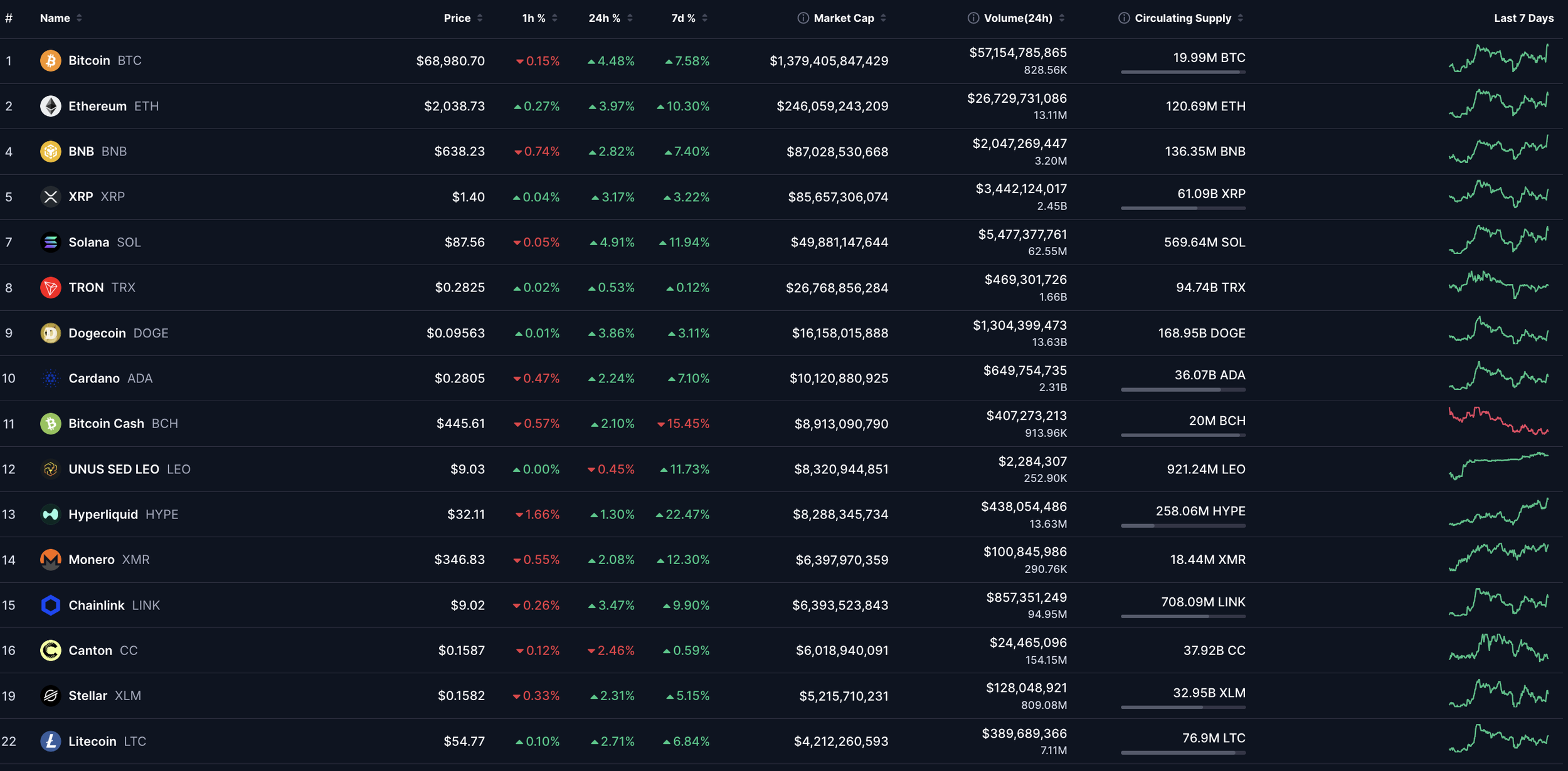
Source: CoinMarketCap
Market Trends:
The crypto market put together a solid recovery week, with total market capitalization climbing from approximately $2.23 trillion to $2.37 trillion (+5.89%). That said, the market was still down roughly 8.64% over the past 30 days and well below its 2025 peak. Bitcoin (BTC) finished the week at $68,980 (+7.58%) while Ethereum (ETH) closed at $2,038 (+10.30%). Gains across large-cap altcoins were broad, with Hyperliquid (HYPE) leading at +22.47%, Solana (SOL) up 11.94%, BNB up 7.40%, and XRP gaining 3.22%. Bitcoin Cash (BCH) was the exception, dropping 15.45% and finishing as the worst performer of the large-caps. The week had three pretty clear phases: a macro-driven selloff to open, a sharp mid-week short squeeze, and a geopolitical shock on Saturday that cut the recovery short.
Crypto prices drifted lower on Sunday as the market struggled to find a footing coming off another rough week. Bitcoin miner Bitdeer dumped its entire weekly BTC production, adding extra spot supply and pushing prices lower. ETF outflows from the prior week, totaling roughly $316 million, were still hanging over the market, and sentiment sat deep in extreme fear. There was no real reason to buy.
Selling accelerated on Monday after President Trump announced plans for a 15% global tariff, sending Bitcoin below $65,000 intraday and pushing the Fear & Greed Index down to 5 out of 100, the lowest reading since the Covid crash in 2020. Data showing a five-week streak of Bitcoin ETF outflows totaling roughly $3.8 billion added to the pressure, and reports of whales moving hundreds of millions in BTC onto Binance with exchange balances at multi-year highs signaled plenty of supply was still sitting overhead. Bitcoin managed to bounce back above $66,000 by the close, but the damage was done.
Prices continued lower on Tuesday, with total market cap hitting the week's lowest print around $2.18 trillion before stabilizing. Altcoins underperformed Bitcoin throughout the session as follow-through selling from the tariff shock kept things heavy. Revised jobs data pushed back Fed rate cut expectations, and renewed regulatory scrutiny of Binance over Iran-linked flows added more noise to an already fragile tape. Sellers were starting to tire, though.
A sharp reversal developed on Wednesday as Bitcoin snapped back from the mid-$60,000s toward the high-$60,000s, pushing total market cap back into the $2.3 trillion range. Roughly $370 million in short liquidations drove most of the move, as four straight days of selling had left shorts crowded and vulnerable. Circle reporting a 77% jump in revenue to about $770 million got attention as a sign of real stablecoin demand under the surface, and a roughly $500 million ETF inflow day led by BlackRock hit around the same time, pushing the move further than short covering alone would have.
Prices pushed to a local high around $2.35 trillion on Thursday before fading back into the low $2.3 trillions. NEAR Protocol rallied into double digits off a major tech upgrade, feeding into the infra narrative that had picked up mid-week. Circle's post-earnings move extended into a nearly 50% stock surge on its own short squeeze. Bitcoin slipped back below $67,000 late in the session, though, as news of a $137 billion U.S. Treasury settlement window started circulating and analysts warned it would drain liquidity from risk assets, including crypto.
Markets consolidated on Friday as Bitcoin ETFs logged roughly $250 million in net inflows, the first positive flow day in weeks, while Ethereum ETFs pulled in only a few million. The Fear & Greed Index ticked up slightly but still sat just below the fear threshold. Two-thirds of the day's liquidations were longs, meaning traders who chased the bounce were getting chopped up even as flows improved. Many were also waiting on regulatory clarity expected around March 1, keeping commitment levels low.
A sharp risk-off move hit on Saturday after reports of U.S.-Israeli strikes on Iran and Iran standing up a national crisis committee surfaced, sending total market cap down to around $2.21 trillion before a partial recovery to roughly $2.32 trillion by late night. Bitcoin fell under $64,000 at the lows while tokenized gold assets XAUT and PAXG jumped 2-4%, once again showing that when real fear hits the tape, gold gets the flows and Bitcoin does not. On-chain analysts also flagged suspected insider trading on Polymarket, where six wallets reportedly made around $1.2 million betting on the Iran strike just hours before it happened.
The recovery was real, but the weight behind it was not convincing. Short covering and one good ETF inflow day carried most of it, while global derivatives open interest stayed roughly 35% below levels from a month ago, and ETF AUM remained well below recent highs. The Fear & Greed Index closed the week at 15, still deep in extreme fear. Until inflows hold up over multiple consecutive weeks and sentiment starts climbing out of that range, rallies are likely to keep running into walls.
Weekly Insight: Crypto's recent rebound: relief rally or new bull leg?
Last week's crypto rebound looked promising on the surface, with total market cap climbing roughly 6% to about $2.40 trillion. However, once you dig deeper, you start to uncover a more cautious narrative. Much of the recent spike came from shorts getting squeezed as Bitcoin pushed back through the $66-68k range. This type of price action looks explosive in the moment, but doesn't always reflect persistent new demand. While ETF inflows flipped positive for the first time in five weeks, the Bitcoin ETF's assets under management are still hovering around $89 billion, far below the $113 billion they reached last month. Additionally, with gold trading above $5,000 and geopolitical tensions still unresolved, it is hard to argue that the broader risk environment has meaningfully improved.
What's even harder to ignore when analyzing whether a rally is simply a short-term relief or the start of a more prolonged bull run is the sentiment side of things. The Fear and Greed Index, a consensus gauge of market sentiment, still sits at 15 on a 1-100 scale, which is extremely deep in the "Extreme Fear" territory, despite several consistent days of gains. While this number did increase from 11 just a week ago, it staying this low indicates that market participants do not actually believe a new bull run has formed and are still defensive, treating rallies like this as mere opportunities to reduce exposure rather than adding to it.
Leverage is also still largely washed out. Open interest sits at around 35% below where it was just a month ago. For this rebound to evolve into something more meaningful, Bitcoin would need to break the $70,000 mark and sit there comfortably. ETF inflows would also likely need to sustain over multiple consecutive weeks for a rebound to be considered the start of something more serious. Lastly, the Fear and Greed Index number would need to normalize toward the 30-50 range, a far less concerning range than where it currently sits. Until these requirements are met, this movement looks largely like a classic bear-market bounce rather than the start of a long-term bull run.
Live Crypto Markets:
Looking Towards the Future
Upcoming Important Economic Events:
Monday: S&P final U.S. manufacturing PMI • ISM manufacturing
Tuesday: Various Fed Presidents and Governors speaking
Wednesday: Various Fed Presidents speaking
Thursday: Initial jobless claims • Fed Vice Chair for Supervision Michelle Bowman testifies to Congress
Friday: Delayed Producer Price Index report (PPI) • Core PPI • Construction Spending • Chicago Business Barometer (PMI)
Future Earnings Reports: