Market Recap (8/23/26)
Market Recap of the Week of Aug 16, 2026 - Aug 23, 2026
Source: Apple Stocks Application
Overall Market Trends:
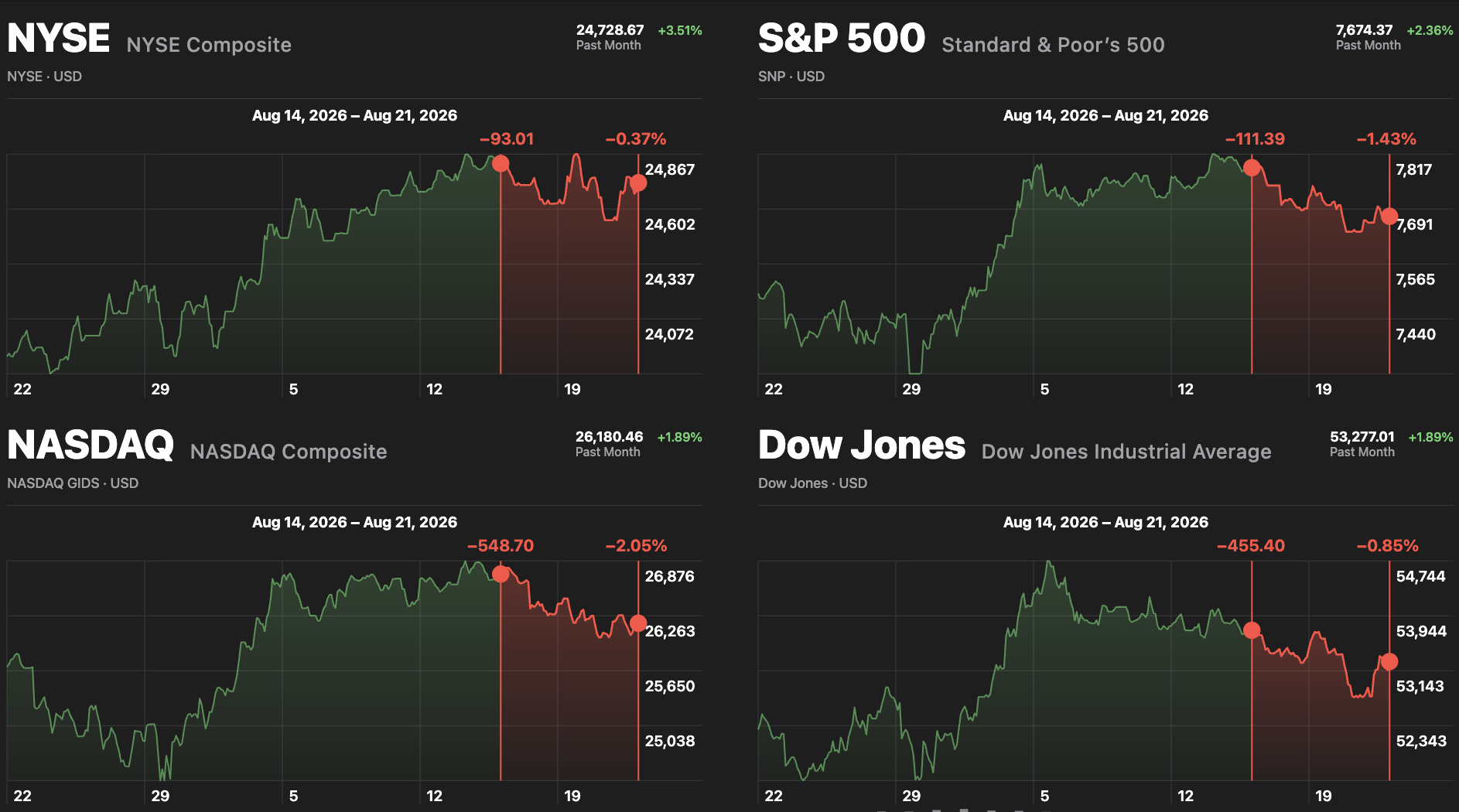
The market fell last week, with all four major indices ending the week in the red. The New York Stock Exchange Composite (NYSE) declined 93 points (-0.37%), the S&P 500 sank 111 points (-1.43%), the NASDAQ Composite tumbled 549 points (-2.05%), and the Dow Jones Industrial Average posted a weekly loss of 455 points (-0.85%). These results were largely influenced by rising global bond yields, elevated oil prices amid tensions between the United States and Iran, and mixed corporate earnings.
Stocks fell on Monday as investors monitored developments in the Middle East. The temporary U.S.-Iran agreement reached its deadline without a permanent deal as negotiations between the two countries remained stalled. The two sides were reportedly further apart than when the agreement was signed. West Texas Intermediate crude rose 2.6% to $84.50 per barrel while Brent crude advanced 2.7% to $90.87. The increase in oil prices contributed to inflation concerns and pushed the 30-year Treasury yield to its highest level since June 2007. Micron Technology (NASDAQ: MU) was a bright spot during the session, climbing roughly 4%. However, this gain was not enough to prevent losses throughout the broader market.
The market continued to decline on Tuesday as sovereign bond yields surged to multiyear highs and semiconductor companies experienced a major sell-off. The 30-year U.S. Treasury yield reached a fresh 19-year high, while Japan’s 10-year yield climbed to its highest level in three decades. Long-term yields in Germany and France also rose to their highest levels in more than a decade. Western Digital (NASDAQ: WDC) fell 7% while Sandisk (NASDAQ: SNDK), Marvell Technology (NASDAQ: MRVL), and Seagate Technology (NASDAQ: STX) tumbled roughly 9%, 8%, and 9%, respectively. Oil prices also continued to rise as hopes for a resolution to the U.S.-Iran conflict faded. President Trump stated that no negotiations with Iran were taking place or scheduled, adding to concerns that elevated energy prices could keep inflation high.
Stocks rebounded slightly on Wednesday after the Treasury Department announced that it would increase its repurchases of longer-term government debt. The department said it would at least double the size of its buyback operations for securities in the 10- to 30-year range. The news initially sent the Dow up more than 360 points before the rally lost momentum later in the session. The 30-year Treasury yield fell more than 10 basis points to 5.184%, while the 10-year yield declined more than 6 basis points to 4.637%. Lowe’s (NYSE: LOW) and Home Depot (NYSE: HD) both rose roughly 2% as lower yields supported rate-sensitive companies. Moderna (NASDAQ: MRNA) skyrocketed 177% after an experimental skin cancer vaccine developed with Merck (NYSE: MRK) delivered successful late-stage trial results. Merck jumped more than 12% as a result. Marvell Technology also rallied nearly 10% after reaching an agreement with Google related to its tensor processing units. However, Broadcom (NASDAQ: AVGO) and Advanced Micro Devices (NASDAQ: AMD) both fell roughly 4% following reports that OpenAI’s quarterly results disappointed investors. The Federal Reserve’s latest meeting minutes also showed that several officials supported raising interest rates if inflation failed to improve.
The market plummeted on Thursday as Treasury yields resumed their climb, erasing much of the relief created by the government’s debt-buyback announcement. The 10-year Treasury yield rose more than 5 basis points to 4.704%, while the 30-year yield advanced to 5.248%. Investors grew concerned that the Treasury Department’s intervention would not be large enough to provide lasting relief to the bond market. Oil prices also moved higher amid escalating tensions between the United States and Iran. West Texas Intermediate crude jumped nearly 3% to $86.83 per barrel while Brent crude rose more than 2% to $93.78. Walmart (NASDAQ: WMT) added to the losses, tumbling 9% after its U.S. comparable sales and adjusted earnings forecast missed expectations. This marked the retail giant’s worst trading session in more than four years and weighed heavily on the Dow.
Stocks rebounded on Friday, although the gains were not enough to offset the losses experienced earlier in the week. Healthcare companies supported the Dow, with Merck and Johnson & Johnson (NYSE: JNJ) leading the sector higher. Financial and cryptocurrency-related stocks also rallied as bitcoin posted a weekly gain of roughly 22%. Robinhood (NASDAQ: HOOD) surged nearly 14% while Coinbase (NASDAQ: COIN) advanced 8%. Materials companies also performed well, with the sector rising roughly 2%. Treasury yields, however, remained elevated as the 10-year yield climbed to 4.734% and the 30-year yield advanced to 5.273%. These continued increases added to concerns about inflation and higher borrowing costs, ultimately leaving all four major indices with weekly losses.
Source: CNBC (Consumer News and Business Channel)
Past Earnings Report:
This Week in Crypto
Live Crypto Markets:
Looking Towards the Future
Upcoming Important Economic Events:
Monday: Markets closed for Labor Day Holiday
Tuesday: Consumer Credit
Wednesday: No events scheduled
Thursday: Weekly jobless claims • Producer Price Index (PPI) • Core PPI
Friday: Consumer Price Index (CPI) • Core CPI
Future Earnings Reports: